Plant profile
Spider Plant
Chlorophytum comosum (Thunb.) Jacques
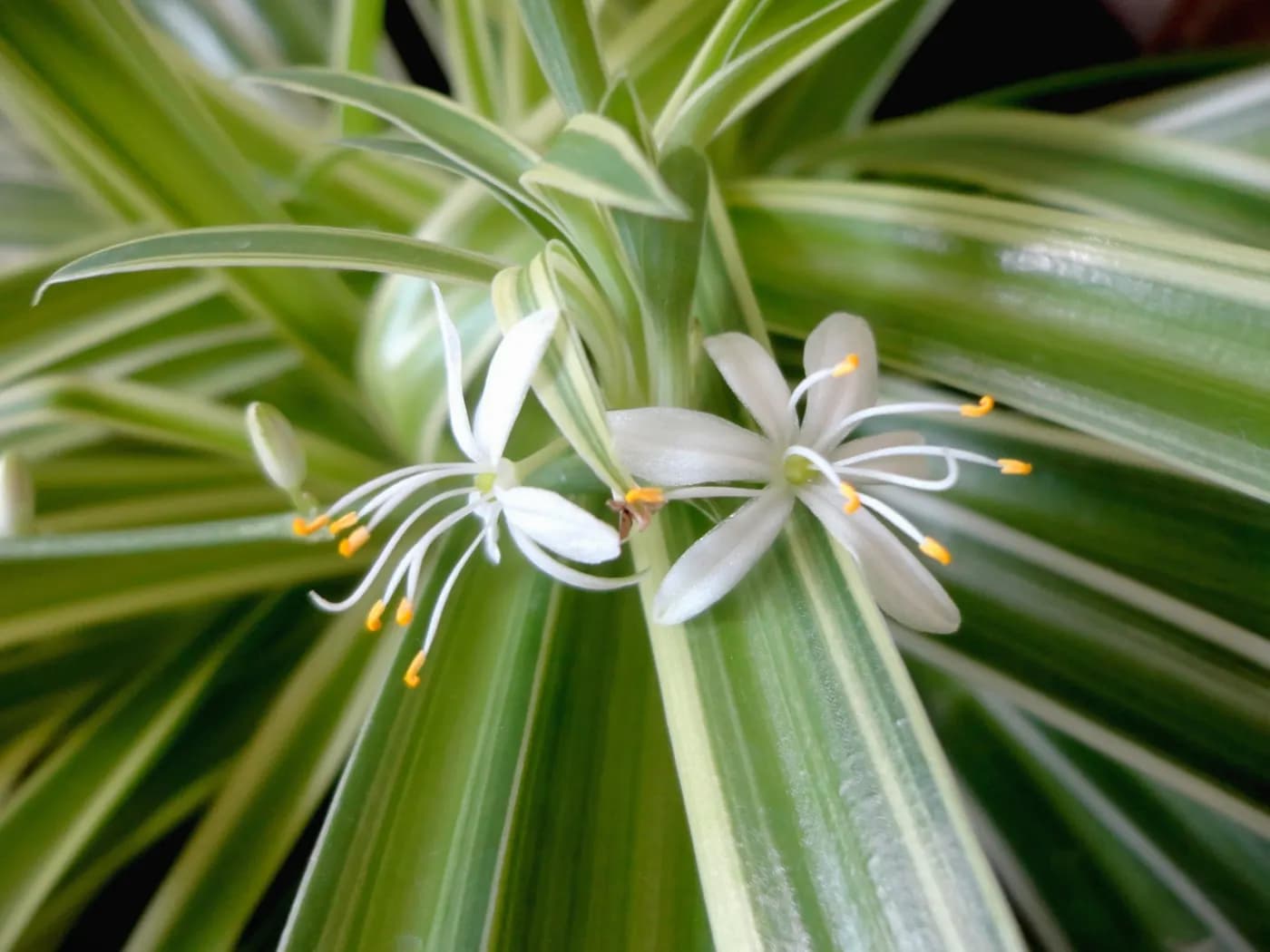
The Spider Plant is an indoor plant with long, arching leaves, suitable for pot cultivation. It has an appealing appearance and is easy to maintain.
From Wikipedia
Chlorophytum comosum, usually called spider plant or common spider plant due to its spider-like look, also known as spider ivy, airplane plant, ribbon plant, and hen and chicks, is a species of evergreen perennial flowering plant of the family Asparagaceae. It is native to tropical and Southern Africa but has become naturalized in other parts of the world, including Western Australia and Bangladesh. Chlorophytum comosum is easy to grow as a houseplant because of its resilience, but it can be sensitive to the fluoride in tap water, which commonly gives it "burnt tips". Variegated forms are the most popular.
Chlorophytum comosum — Text CC BY-SA. See the original article.
Open-data facts
- Life form
- Its biology is perennial, not strictly annual.
- Climate
- Tropical climate with a dry season: warmth and a clearly defined dry period.
- Origin / area
- Documented area of origin: W. Trop. Africa to Cameroon, Ethiopia to S. Africa.
- Native distribution
- Cited native regions: Ivory Coast, Western Tropical Africa, Africa · Liberia, Western Tropical Africa, Africa · Nigeria, Western Tropical Africa, Africa · Sierra Leone, Western Tropical Africa, Africa · Burundi, West-Central Tropical Africa, Africa · Cameroon, West-Central Tropical Africa, Africa · Equatorial Guinea, West-Central Tropical Africa, Africa · Gulf of Guinea Islands, West-Central Tropical Africa, Africa · Ethiopia, Northeast Tropical Africa, Africa · Sudan-South Sudan, Northeast Tropical Africa, Africa · Kenya, Eastern Tropical Africa, Africa · Tanzania, Eastern Tropical Africa, Africa.
- Documented uses
- Environmental · ornamental
Traits (USDA)
- Botanical group
- USDA classification: Monocot. In practice, a plant with a single cotyledon.
- Duration
- It's perennial, so there's no need to re-sow every spring if the climate allows.
- Growth habit
- Grows like a broadleaf grass, without hard wood in the stems.
Recommended products for Spider Plant
Ecological interactions
Organisms that live on it:
Scopula nigrinotata, Agroathelia rolfsii, Phyllosticta sp., Globisporangium splendens, Rhizoctonia solani, Cercospora sp., Colletotrichum sp., Alternaria sp.…
Associated herbivores:
Apis mellifera, Allograpta obliqua, Aspidiotus nerii
Basic care
- Watering
- In heatwaves, water a bit more—without overdoing it.
- Light
- An east or west window with some filter often works well.
- Temperature
- Fits typical home ranges (neither icy nor baking).
- Humidity
- Moderate humidity plus good air movement.
Pet toxicity
On common guidance, it is not usually toxic to cats or dogs.
Cats: no (typical guidance). Dogs: no (typical guidance).
Sources
- Wikidata (Q1164349) — taxonomic data CC0
- GBIF (2774846) — taxonomy and vernacular names
- POWO / WCVP (532810-1) — taxonomy and distribution (WCVP/Kew, CC BY)
- WFO (wfo-0000763291) — world taxonomic checklist (CC0)
- USDA GRIN — uses and distribution (USDA GRIN, public domain)
- USDA PLANTS (CHCO28) — conservation characteristics (USDA PLANTS, public domain)
- Wikipedia — lead extract (CC BY-SA)
- GloBI — species interactions (CC BY)
- Care texts are Botanico templates chosen by each plant’s care level (guidance only).