Plant profile
Fiddle-leaf fig
Ficus lyrata Warb.
Family: Moraceae · Genus: Ficus
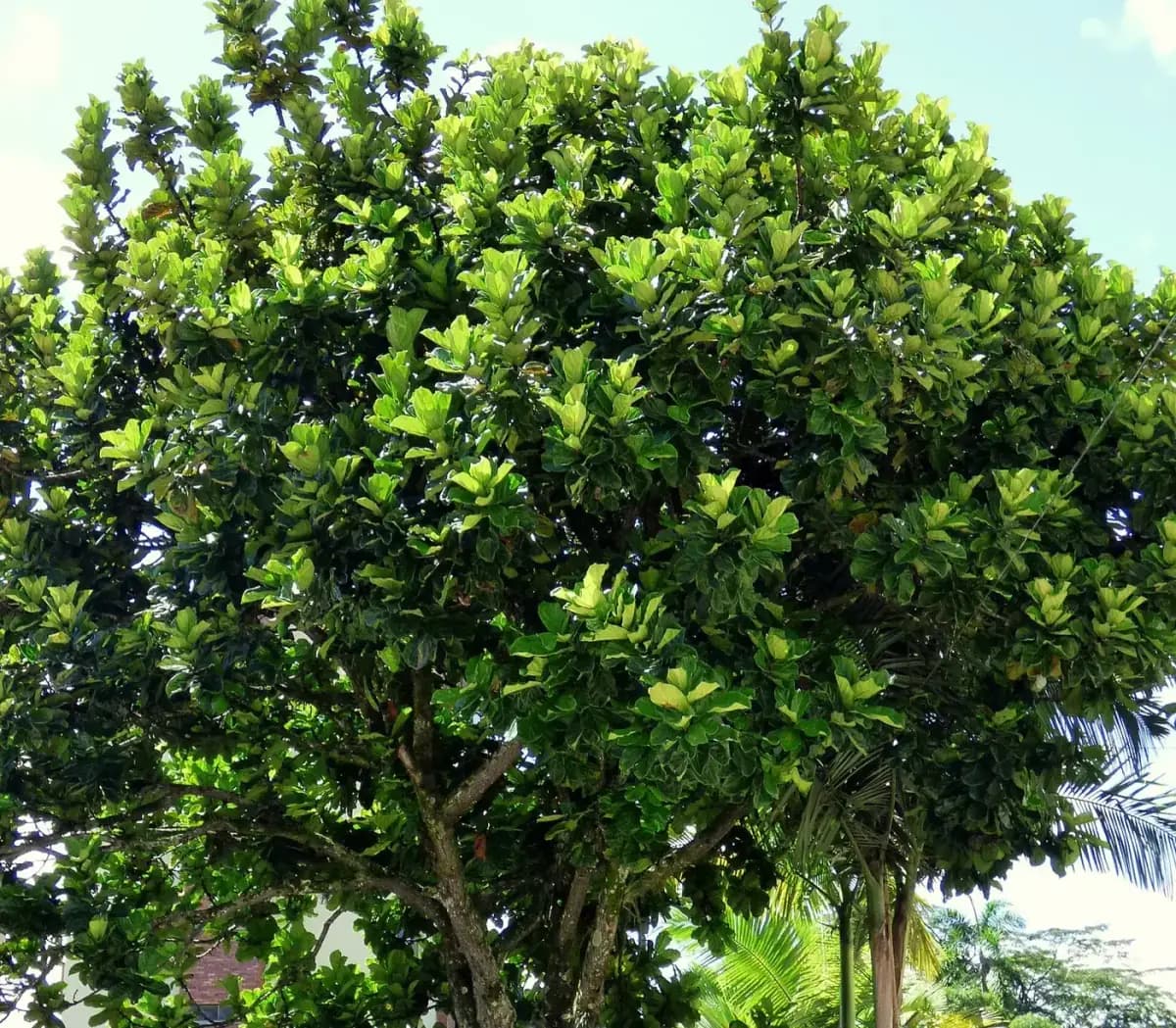
Indoor tree with large fiddle-shaped leaves. Needs steady light and patience.
From Wikipedia
Ficus lyrata, commonly known as the fiddle-leaf fig, banjo fig, fiddle-leaved fig tree, lyre leaf fig tree, or lyre-leaved fig tree, is a species of plant in the mulberry and fig family Moraceae. It is native to western Africa, but is cultivated around the world as an ornamental plant. It has received the Royal Horticultural Society's Award of Garden Merit.
Ficus lyrata — Text CC BY-SA. See the original article.
Open-data facts
- Life form
- Hemiepiphytic tree in its natural ecology.
- Climate
- Native climate: humid tropical. High warmth and ambient humidity.
- Origin / area
- The typical geographical origin is: Western and Central Tropical Africa.
- Native distribution
- In its wild area, it can be found in: Benin, Western Tropical Africa, Africa · Ghana, Western Tropical Africa, Africa · Guinea-Bissau, Western Tropical Africa, Africa · Guinea, Western Tropical Africa, Africa · Ivory Coast, Western Tropical Africa, Africa · Liberia, Western Tropical Africa, Africa · Nigeria, Western Tropical Africa, Africa · Sierra Leone, Western Tropical Africa, Africa · Togo, Western Tropical Africa, Africa · Cameroon, West-Central Tropical Africa, Africa · Gabon, West-Central Tropical Africa, Africa.
- Documented uses
- Environmental · ornamental
Traits (USDA)
- Botanical group
- It's a dicot: many herbs, shrubs, and ornamental trees fall into this category.
- Duration
- It's not a one-year plant: its life cycle is perennial.
- Growth habit
- Tree habit: potential for large woody growth.
Recommended products for Fiddle-leaf fig
Ecological interactions
Animals that eat this plant:
Euploea core, Calyptorhynchus banksii, Hypsignathus monstrosus
Hosts these species:
Agaon spatulatum, Cercospora sp., Colletotrichum sp., Helminthosporium sp., Phyllosticta sp., Colletotrichum gloeosporioides, Cephalosporium sp., Cylindrocladium sp.…
Basic care
- Watering
- Medium frequency; adjust for heat and pot size.
- Light
- If colour fades, it usually wants a bit more brightness.
- Temperature
- Outside a mild indoor range, protect the plant.
- Humidity
- Prefers less dry air than a typical living room.
Pet toxicity
Leaves and stems are not for pets to play with or eat.
Cats: yes (toxic). Dogs: yes (toxic).
Sources
- Wikidata (Q1498748) — taxonomic data CC0
- GBIF (5361899) — taxonomy and vernacular names
- POWO / WCVP (853158-1) — taxonomy and distribution (WCVP/Kew, CC BY)
- WFO (wfo-0001084874) — world taxonomic checklist (CC0)
- USDA GRIN — uses and distribution (USDA GRIN, public domain)
- USDA PLANTS (FILY) — conservation characteristics (USDA PLANTS, public domain)
- Wikipedia — lead extract (CC BY-SA)
- GloBI — species interactions (CC BY)
- Care texts are Botanico templates chosen by each plant’s care level (guidance only).