Plant profile
eastern teaberry
Gaultheria procumbens L.
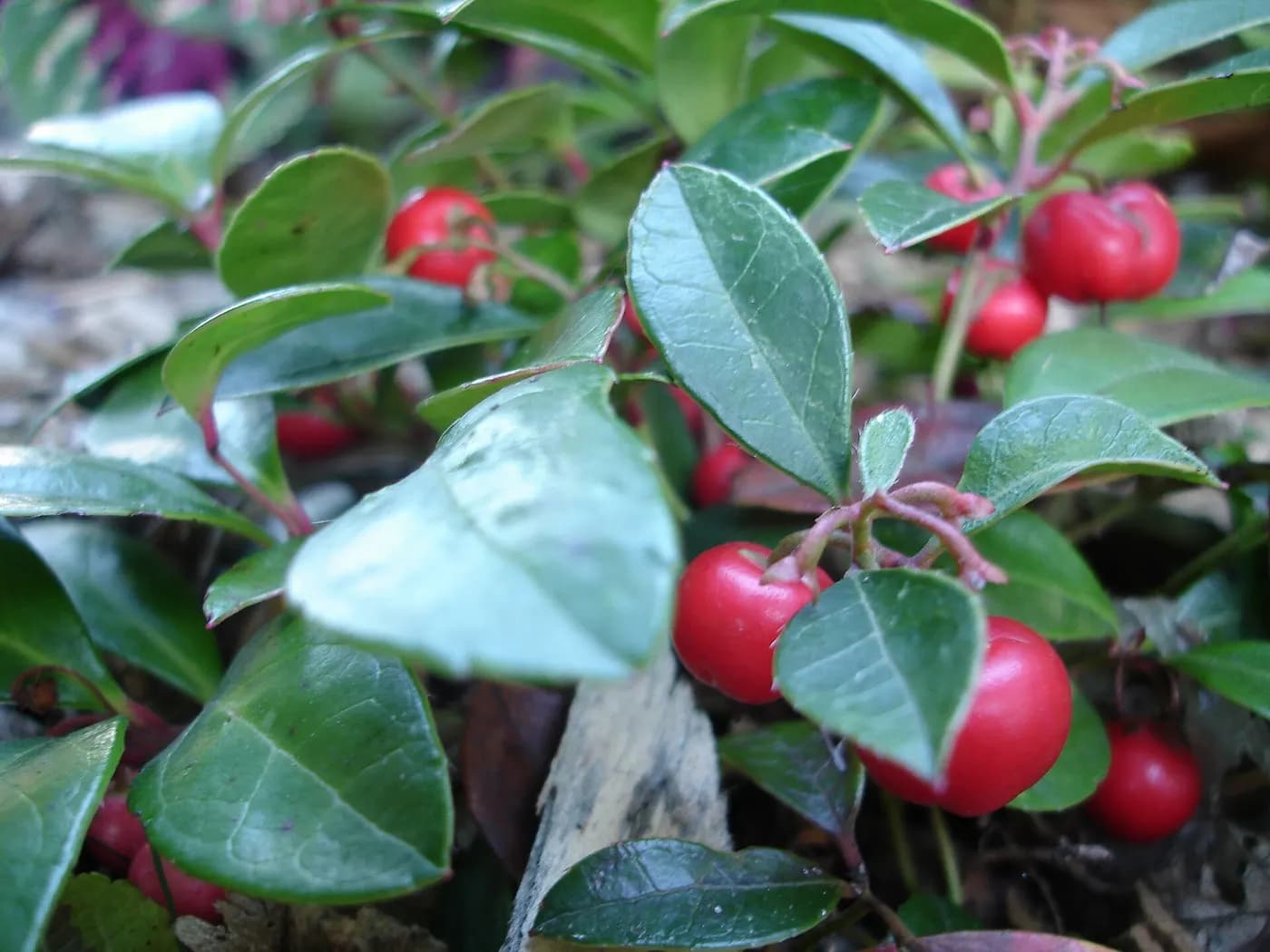
An outdoor groundcover with glossy evergreen leaves and red berries. Grow it in shade or partial shade, in moist, well-drained acidic soil.
From Wikipedia
Gaultheria procumbens, also called the eastern teaberry, the checkerberry, the boxberry, or the American wintergreen, is a perennial species of Gaultheria native to northeastern North America from Newfoundland west to southeastern Manitoba, and south to Alabama. It is a member of the Ericaceae.
Gaultheria procumbens — Text CC BY-SA. See the original article.
Open-data facts
- Life form
- It is perennial or subshrubby depending on age and conditions.
- Climate
- Temperate zones define its natural range.
- Origin / area
- Documented area of origin: C. & E. Canada to NC. & E. U.S.A..
- Documented uses
- Medicines · Materials · Food additives
Traits (USDA)
- Botanical group
- Botanically, it's a dicot, in contrast to monocots like lilies or palms.
- Duration
- As a perennial plant, it can age and continue producing new shoots.
- Growth habit
- Growth form: subshrub to shrubby.
- Drought tolerance
- High
- Shade tolerance
- Tolerant
- Moisture use
- Low
- Soil pH
- 4 – 6.5
- Mature height
- 0.5 ft
- Bloom period
- Spring
- Toxicity (USDA)
- None
Recommended products for eastern teaberry
Ecological interactions
Uses it as a host:
Gibbera gaultheriae, Stomiopeltis gaultheriae, Schizothyrium gaultheriae, Pseudocercospora gaultheriae, Venturia arctostaphyli, Phyllosticta, Phyllosticta gaultheriae, Mycosphaerella gaultheriae…
Eaten by:
Vulpes vulpes, Ursus americanus, Tamias striatus, Peromyscus leucopus, Meleagris gallopavo, Catharus guttatus, Bonasa umbellus, Tympanuchus phasianellus…
Can be affected by pathogens such as:
Phytophthora ramorum
Who pollinates this plant:
Apoidea
Basic care
- Watering
- In heatwaves, water a bit more—without overdoing it.
- Light
- An east or west window with some filter often works well.
- Temperature
- A cool, steady indoor climate beats strong heat.
- Humidity
- Appreciates higher-than-average air humidity.
Pet toxicity
In a pet household, prioritise an inaccessible spot.
Cats: yes (toxic). Dogs: yes (toxic).
Sources
- Wikidata (Q386770) — taxonomic data CC0
- GBIF (2882753) — taxonomy and vernacular names
- POWO / WCVP (330655-1) — taxonomy and distribution (WCVP/Kew, CC BY)
- WFO (wfo-0000695341) — world taxonomic checklist (CC0)
- USDA GRIN — uses and distribution (USDA GRIN, public domain)
- USDA PLANTS (GAPR2) — conservation characteristics (USDA PLANTS, public domain)
- Wikipedia — lead extract (CC BY-SA)
- GloBI — species interactions (CC BY)
- Care texts are Botanico templates chosen by each plant’s care level (guidance only).