Plant profile
English lavender
Lavandula angustifolia Mill.
Family: Lamiaceae · Genus: Lavandula
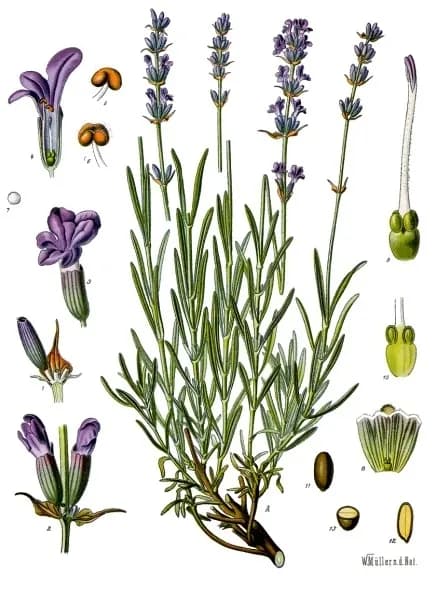
Outdoor aromatic with violet blooms and strong scent. Needs sun and sharp drainage.
From Wikipedia
Lavandula angustifolia, formerly L. officinalis, is a flowering plant in the family Lamiaceae, native to the Mediterranean basin. Its common names include lavender, true lavender and English lavender ; also garden lavender, common lavender and narrow-leaved lavender.
Lavandula angustifolia — Text CC BY-SA. See the original article.
Open-data facts
- Life form
- Life form of a Mediterranean subshrub or similar.
- Climate
- Temperate zones define its natural range.
- Origin / area
- Documented area of origin: Northeast Spain to Italy.
- Native distribution
- It typically appears natively in: France, Southwestern Europe, Europe · Spain, Southwestern Europe, Europe · Italy, Southeastern Europe, Europe.
Traits (USDA)
- Botanical group
- As a dicot, it belongs to the large group of plants with two cotyledons.
- Duration
- Perennial plant: once established, it can accompany you through many seasons.
- Growth habit
- Grows in a woody clump (shrub).
Recommended products for English lavender
Ecological interactions
Associated pollinator organisms:
Apis mellifera, Anthophora dispar, Lasioglossum sabulosum, Osmia viridana, Lasioglossum clypeare, Lasioglossum interruptum, Anthophora aestivalis, Halictus leucaheneus…
Eaten by:
Eupteryx zelleri, Sophronia humerella, Heliothis peltigera, Synopsia sociaria, Agdistis adactyla, Eupteryx melissae, Idaea litigiosaria, Perconia strigillaria…
Hosts:
Phytophthora plurivora, Phytophthora cactorum, Fusarium solani, Phytophthora citrophthora, Phytophthora tentaculata, Phoma exigua var. exigua, Coniothyrium lavandulae, Phomopsis lavandulae…
Can be affected by pathogens such as:
no name
Basic care
- Watering
- Water when the top few centimetres of soil feel dry.
- Light
- Harden it off gradually if it came from shade.
- Temperature
- Protect from hard cold, especially in pots.
- Humidity
- Tolerates dry air; no humidifier needed.
Pet toxicity
On common guidance, it is not usually toxic to cats or dogs.
Cats: no (typical guidance). Dogs: no (typical guidance).
Sources
- Wikidata (Q42081) — taxonomic data CC0
- GBIF (2927305) — taxonomy and vernacular names
- POWO / WCVP (449008-1) — taxonomy and distribution (WCVP/Kew, CC BY)
- WFO (wfo-0000224115) — world taxonomic checklist (CC0)
- USDA GRIN — uses and distribution (USDA GRIN, public domain)
- USDA PLANTS (LAAN81) — conservation characteristics (USDA PLANTS, public domain)
- Wikipedia — lead extract (CC BY-SA)
- GloBI — species interactions (CC BY)
- Care texts are Botanico templates chosen by each plant’s care level (guidance only).