Plant profile
Kotzebue's Parnassia
Parnassia kotzebuei Cham. ex Spreng.
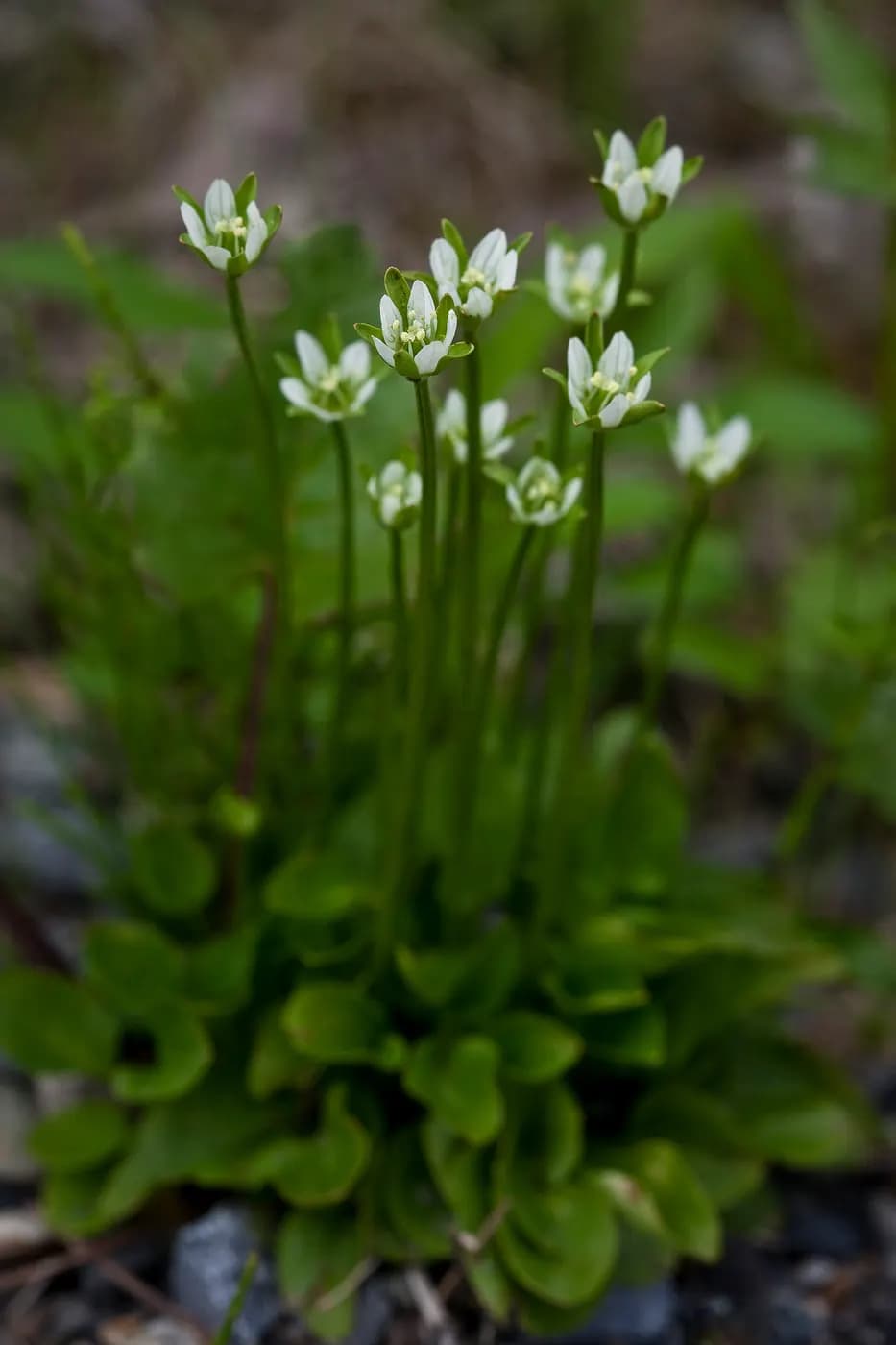
Kotzebue's Parnassia is a plant suitable for both indoor and outdoor cultivation, characterized by its white flowers and elegant shape.
Open-data facts
- Life form
- Stable and multi-year life form.
- Climate
- subalpine or subarctic
- Origin / area
- In its natural state, it is primarily linked to: NE. Siberia to N. Russian Far East, Subarctic America to Rocky Mts..
Traits (USDA)
- Botanical group
- Dicot means that the seedling starts with a pair of embryonic leaves.
- Duration
- As a perennial plant, it can age and continue producing new shoots.
- Growth habit
- As a forb, its structure is more herbaceous than woody.
Recommended products for Kotzebue's Parnassia
Ecological interactions
Documented ecological contacts:
Parnassia kotzebuei, Oxytropis viscida, Polemonium boreale, and Poa sp., Gentianella propinqua subsp. propinqua, Puccinellia phyrganoides, Leymus mollis, Carex macrochaeta…
Uses it as a host:
Puccinia uliginosa, Mycosphaerella tassiana var. tassiana
Basic care
- Watering
- Water when the top few centimetres of soil feel dry.
- Light
- Too much shade slows it; too much sun stresses it.
- Temperature
- Sudden temperature swings stress it.
- Humidity
- A middle humidity level keeps the plant steady.
Pet toxicity
Still, don’t let pets eat large amounts—any plant can upset a stomach.
Cats: no (typical guidance). Dogs: no (typical guidance).
Sources
- Wikidata (Q17240631) — taxonomic data CC0
- GBIF (3032575) — taxonomy and vernacular names
- POWO / WCVP (30087162-2) — taxonomy and distribution (WCVP/Kew, CC BY)
- WFO (wfo-0001135375) — world taxonomic checklist (CC0)
- USDA GRIN — uses and distribution (USDA GRIN, public domain)
- USDA PLANTS (PAKO3) — conservation characteristics (USDA PLANTS, public domain)
- GloBI — species interactions (CC BY)
- Care texts are Botanico templates chosen by each plant’s care level (guidance only).