Plant profile
Rosemary
Salvia rosmarinus Spenn.
Family: Lamiaceae · Genus: Salvia
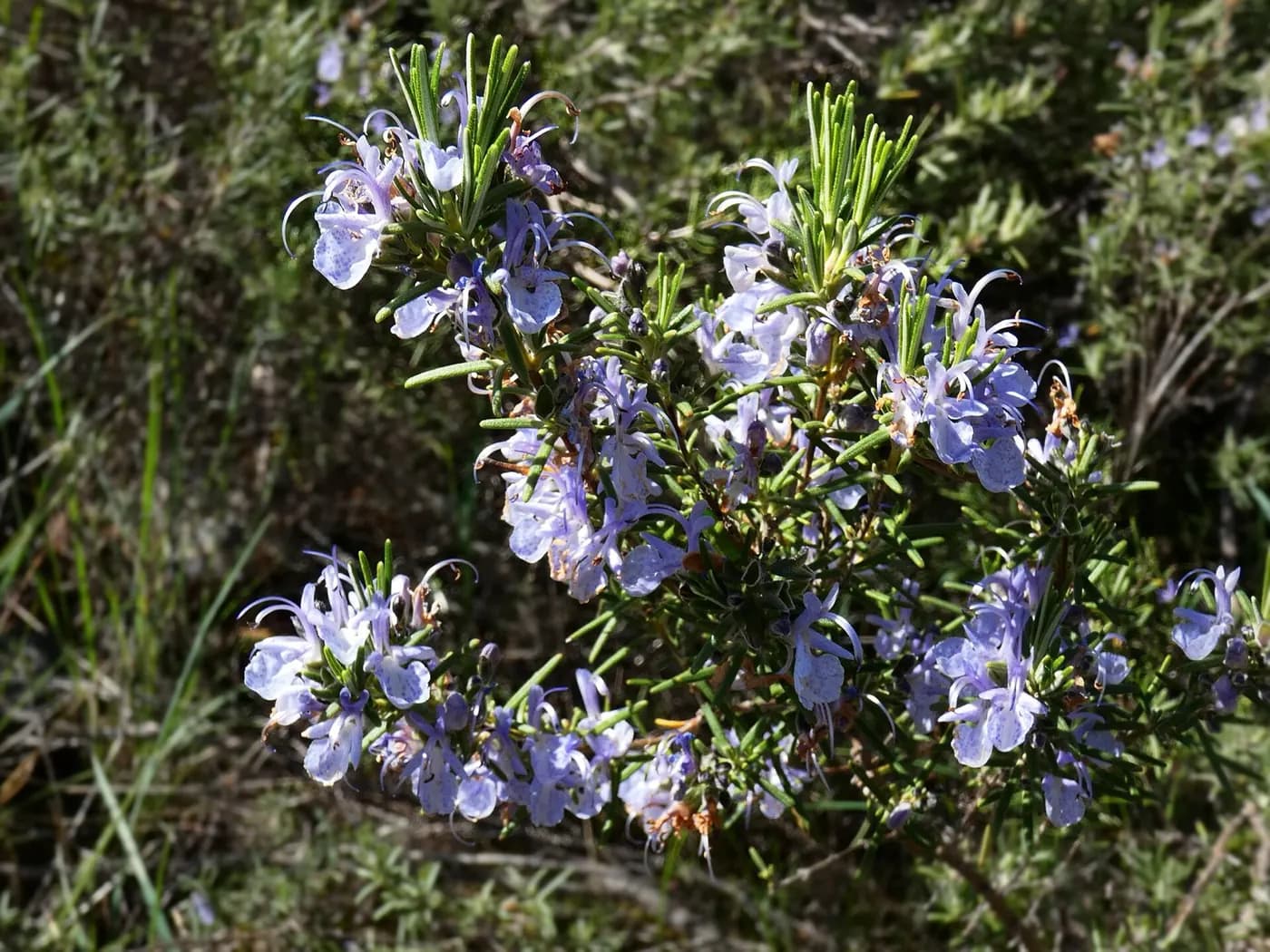
Mediterranean kitchen herb for garden or sunny patio. Sun, air, and lean draining soil.
From Wikipedia
Salvia rosmarinus, synonym Rosmarinus officinalis, commonly known as rosemary, is a shrub with fragrant, evergreen, needle-like leaves and purple or sometimes white, pink, or blue flowers. It is a member of the mint family, Lamiaceae. The species is native to the Mediterranean region. It has numerous cultivars, and its leaves are commonly used as a flavoring.
Rosemary — Text CC BY-SA. See the original article.
Open-data facts
- Life form
- Shrub: persistent and branched.
- Climate
- Temperate climate: neither humid equatorial nor extreme desert.
- Origin / area
- Geographical area of origin: Mediterranean.
- Native distribution
- The native distribution by countries and regions includes: Balearic Islands, Southwestern Europe, Europe · Corsica, Southwestern Europe, Europe · France, Southwestern Europe, Europe · Portugal, Southwestern Europe, Europe · Sardinia, Southwestern Europe, Europe · Spain, Southwestern Europe, Europe · Albania, Southeastern Europe, Europe · Greece, Southeastern Europe, Europe · Italy, Southeastern Europe, Europe · Sicily, Southeastern Europe, Europe · Northwest Balkan Peninsula, Southeastern Europe, Europe · Algeria, Northern Africa, Africa.
Traits (USDA)
- Botanical group
- It's a dicot: many herbs, shrubs, and ornamental trees fall into this category.
- Duration
- This is a perennial plant: it lives for several years and re-sprouts season after season.
- Growth habit
- Grows as a compact woody clump (subshrub/shrub).
- Drought tolerance
- High
- Shade tolerance
- Intolerant
- Moisture use
- Low
- Soil pH
- 5 – 7.5
- Mature height
- 5 ft
- Bloom period
- Mid Spring
- Toxicity (USDA)
- None
Recommended products for Rosemary
Ecological interactions
Appears in the diet of:
Eupteryx decemnotata, no name, Clastoptera stolida, Neoaliturus haematoceps, Neoaliturus opacipennis, Eupteryx zelleri, Eupteryx melissae, Philaenus spumarius…
Serves as a host to:
Glaucolepis rosmarinella, Stigmella rosmarinella, Vulcaniella rosmarinella, Symmoca signatella, Pyrausta phoenicealis, Agapostemon tyleri, Agapostemon (Agapostemon) angelicus
Basic care
- Watering
- Ease off a little if the room is cool or dim.
- Light
- Give it the brightest aspect you have.
- Temperature
- Ideal in warmer climates or cosier corners of the home.
- Humidity
- Avoid damp corners with no airflow.
Pet toxicity
Not among the plants typically listed as pet-toxic.
Cats: no (typical guidance). Dogs: no (typical guidance).
Sources
- Wikidata (Q102240169) — taxonomic data CC0
- GBIF (10902460) — taxonomy and vernacular names
- POWO / WCVP (457138-1) — taxonomy and distribution (WCVP/Kew, CC BY)
- WFO (wfo-0000302167) — world taxonomic checklist (CC0)
- USDA PLANTS (ROOF) — conservation characteristics (USDA PLANTS, public domain)
- Wikipedia — lead extract (CC BY-SA)
- GloBI — species interactions (CC BY)
- Care texts are Botanico templates chosen by each plant’s care level (guidance only).