Plant profile
Georgia Aster
Symphyotrichum georgianum (Alexander ex Small) G.L.Nesom
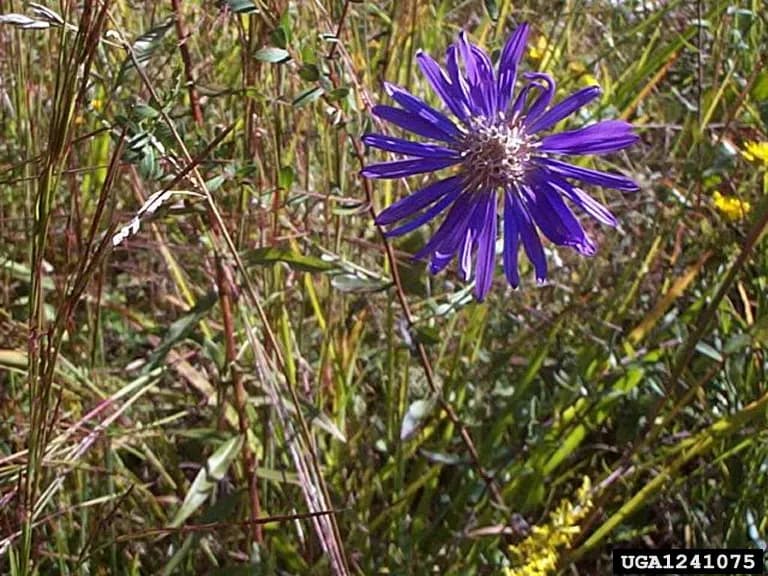
The Georgia Aster is a perennial plant suitable for both indoor and outdoor cultivation, known for its purple flowers. It thrives in well-drained soils and can be grown from seeds or cuttings.
From Wikipedia
Symphyotrichum georgianum is a rare species of flowering plant in the Asteraceae, the aster family. Its common name is Georgia aster. It is native to the southeastern United States where it is known from Alabama, Florida, Georgia, North Carolina, and South Carolina. As of 2013, it may be extirpated from the state of Florida.
Symphyotrichum georgianum — Text CC BY-SA. See the original article.
Open-data facts
- Life form
- Remains season after season.
- Climate
- Adapted to temperate climates with seasonal variation.
- Origin / area
- Its geographical roots are located in: SE. U.S.A..
Traits (USDA)
- Botanical group
- It is part of the dicots, the most common group in garden and vegetable plants.
- Duration
- Lives for more than one season: its cycle is perennial.
- Growth habit
- Herbaceous habit (forb): non-woody stems, typical of broadleaf herbs.
Recommended products for Georgia Aster
Basic care
- Watering
- Ease off a little if the room is cool or dim.
- Light
- Bright indirect light: near a window without full sun.
- Temperature
- Comfortable indoor temperatures, without extremes.
- Humidity
- In dry winters, watch leaves and watering—don’t overdo either.
Pet toxicity
Generally considered low-risk for cats and dogs.
Cats: no (typical guidance). Dogs: no (typical guidance).
Sources
- Wikidata (Q7661730) — taxonomic data CC0
- GBIF (3151663) — taxonomy and vernacular names
- POWO / WCVP (1156971-2) — taxonomy and distribution (WCVP/Kew, CC BY)
- WFO (wfo-0000006578) — world taxonomic checklist (CC0)
- USDA PLANTS (SYGE) — conservation characteristics (USDA PLANTS, public domain)
- Wikipedia — lead extract (CC BY-SA)
- Care texts are Botanico templates chosen by each plant’s care level (guidance only).