Plant profile
Tomato
Solanum lycopersicum L.
Family: Solanaceae · Genus: Solanum
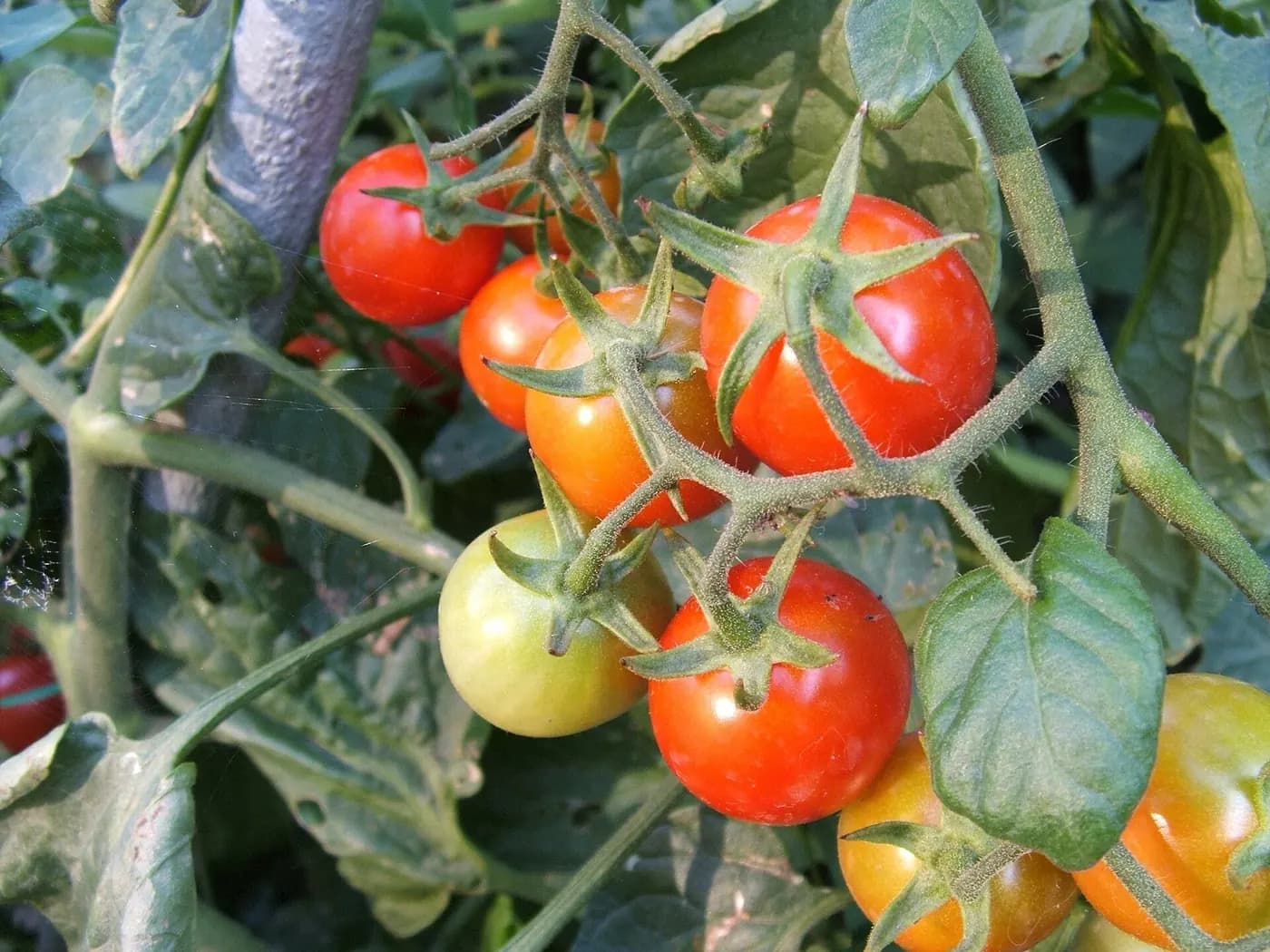
Sun-loving crop for gardens or large pots with support.
From Wikipedia
The tomato is a plant whose fruit is an edible berry that is eaten as a vegetable. The tomato is a member of the nightshade family that includes tobacco, potato, and chili peppers. It originated from western South America, and may have been domesticated there, in Mexico, or in Central America. The Spanish introduced tomatoes to Eurasia in the Columbian exchange in the 16th century.
Tomato — Text CC BY-SA. See the original article.
Open-data facts
- Life form
- Develops by leaning, without being a tree.
- Climate
- Ecology of a rainy tropical climate.
- Origin / area
- Geographical area of origin: as a cultivated variety from Peru.
- Native distribution
- Its native range spans: Peru, Western South America, South America.
- Documented uses
- Medicines · Vertebrate poisons
Traits (USDA)
- Botanical group
- It is part of the dicots, the most common group in garden and vegetable plants.
- Duration
- It's a mixed cycle species (annual/perennial) depending on conditions.
- Growth habit
- Grows as a perennial or annual broadleaf herb.
Recommended products for Tomato
Ecological interactions
Known consumers:
Leptinotarsa decemlineata, Nesidiocoris tenuis, Meloidogyne incognita, Agrotis ipsilon, Peridroma saucia, Trialeurodes vaporariorum, Bombus pauloensis, Neoleucinodes elegantalis…
Known pathogenic agents:
Tospovirus Groundnut bud necrosis virus, Autographa gamma, Spodoptera litura, Chrysodeixis chalcites, Helicoverpa armigera, Neoleucinodes elegantalis, Ralstonia solanacearum race 3 biovar 2, Tuta absoluta…
Who carries the pollen of this plant:
Bombus pauloensis, Apis mellifera, Lonchophylla concava, Agylla nr argentifera 1154, Halictidae, Bombus lapidarius, Self pollinated, Anthophora…
Serves as a host to:
Septoria lycopersici, Fulvia fulva, Ascochyta socia, Alternaria tomato, Septoria hortensis, Remotididymella destructiva, Alternaria solani, Didymella lycopersici…
Species it can parasitize:
Bemisia tabaci
Basic care
- Watering
- A mix that dries out completely slows growth.
- Light
- Sunny outdoors or a strongly exposed window.
- Temperature
- Don’t leave it outdoors in hard frosts.
- Humidity
- Avoid both very dry air and constant vapour.
Pet toxicity
Can be toxic to cats and dogs if chewed or swallowed.
Cats: yes (toxic). Dogs: yes (toxic).
Sources
- Wikidata (Q23501) — taxonomic data CC0
- GBIF (2930137) — taxonomy and vernacular names
- POWO / WCVP (316947-2) — taxonomy and distribution (WCVP/Kew, CC BY)
- WFO (wfo-0001029216) — world taxonomic checklist (CC0)
- USDA GRIN — uses and distribution (USDA GRIN, public domain)
- USDA PLANTS (SOLY2) — conservation characteristics (USDA PLANTS, public domain)
- Wikipedia — lead extract (CC BY-SA)
- GloBI — species interactions (CC BY)
- Care texts are Botanico templates chosen by each plant’s care level (guidance only).